
Skillport: Claude Skill Sharing at Scale
Or: How I spent my Christmas vacation.
To explain why I created the open source project Skillport, I need to provide some background.
First, know that, starting in 2024 and throughout 2025, I’ve been working with clients to apply AI in critical business workflows, cobbling together Claude, lots of MCPs, and lots of large, complicated prompts. The results were often fantastic—what used to take days done in a few hours—but the cobbling together part was painful, as were the realities of deploying and running first-generation local MCPs.
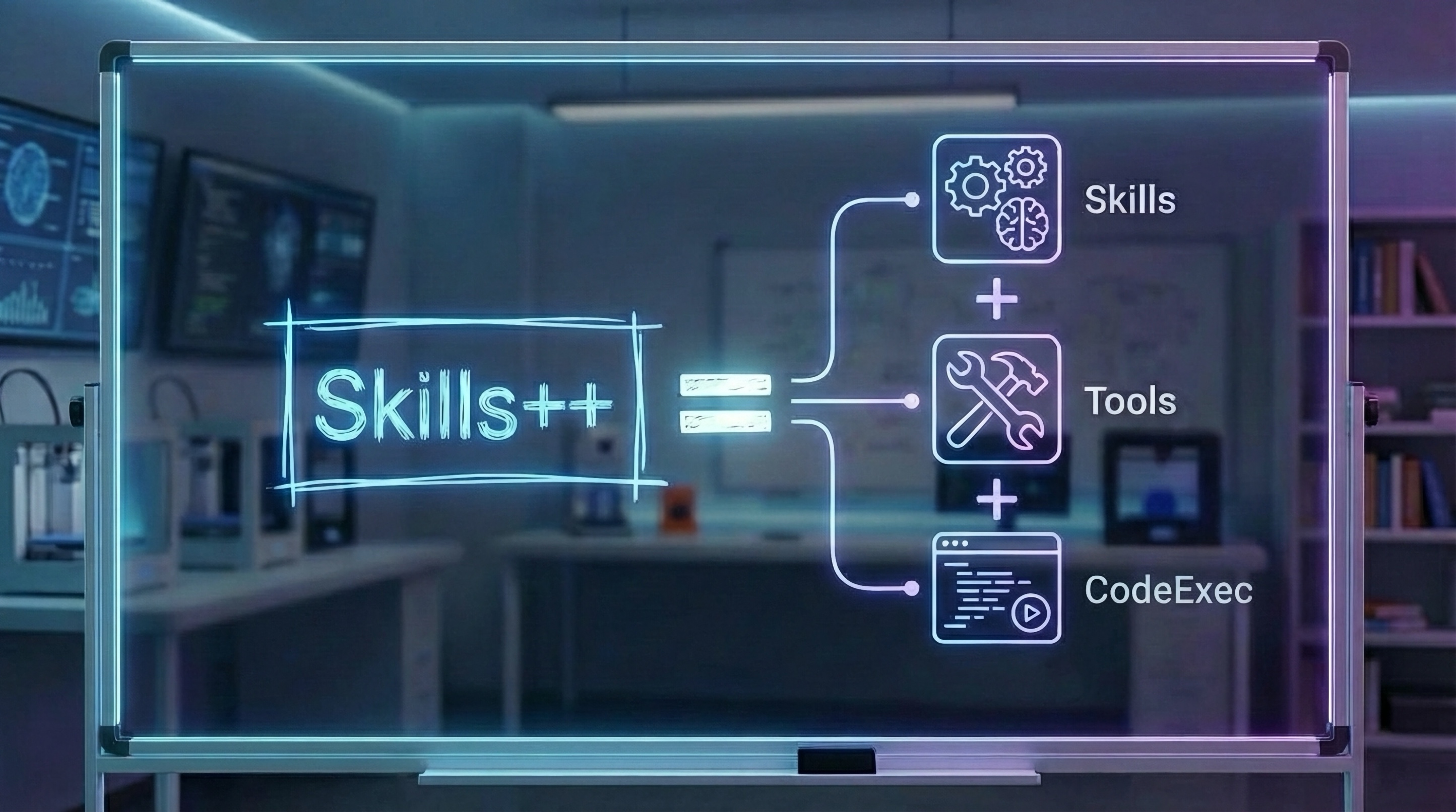
Second, Skillport was made possible by Anthropic’s great work during 2025, and we’ll need to explore that a bit to set the stage, focusing on work related to what I call Skills++, the combination of:
- Skills are fantastic, but to be powerful they need …
- Tools, often exposed over the Model Context Protocol, MCP, providing critical business context and data; and …
- Sandboxed code execution, essential for advanced Skills and efficient tool use.
Anthropic’s Fantastic Year in Skills++
I asked Claude Opus 4.5 to give me Anthropic’s 2025 timeline of important announcements and releases that pertained to Skills++:
Here’s the condensed version of that list:
| Date | Announcement | Why Important to Skills++ |
|---|---|---|
| May 22 | Code Execution Tool: Python sandbox | Code execution arrives. Claude (even on web and mobile) can now run Python in a sandboxed environment. |
| Jun 26 | Desktop Extensions (DXT) — One-click local MCP installation | Packaging format for local MCPs. .dxt bundles MCP servers with dependencies into single installable files. Node.js ships with Claude Desktop, eliminating dependency hell. Open-sourced spec enables ecosystem-wide adoption. |
| Jul 14 | Connectors Directory | MCP becomes consumer-visible with one-click tool connections in Claude.ai and Desktop |
| Aug 25 | Code Execution update: Bash + file operations | Foundation for Skills runtime. Bash support means Skills can run shell scripts, install packages, and manipulate files — the primitives that make document-creation Skills possible. |
| Sep 9 | Create and edit files — Skills-powered file creation | Skills’ first killer app. This feature is entirely powered by Skills internally (docx, xlsx, pptx, pdf). Proves the Skills architecture works for end-users, not just developers. |
| Sep 29 | Claude Agent SDK | Skills infrastructure goes public. The Agent SDK is the same runtime that powers Claude Code. Now any developer can build agents with the same primitives Anthropic uses internally. |
| Oct 16 | Skills launch — Public Skills + /v1/skills API | The main event. Skills become a first-class API primitive. Developers can create, version, and deploy Skills. Enterprise customers can manage Skills organization-wide. |
| Oct 20 | Claude Code on the web — Browser-based coding agent | Claude Code escapes the terminal. Developers can delegate coding tasks from browser or mobile. Runs in Anthropic-managed sandboxes with GitHub integration. Parallel task execution means overseeing a “fleet” of coding agents. |
| Oct 21 | Create and edit files GA — Network/egress controls | Enterprise-ready Skills execution. Admins can control what Skills can access (package managers only, allowlisted domains, or full internet). Critical for regulated industries. |
| Oct 27 | Financial Services Agent Skills | Domain Skills arrive. Six specialized Skills for finance: DCF models, comp analysis, due diligence packs, company teasers, earnings analyses, and coverage reports. Proves Skills can encode professional domain expertise, not just document formats. |
| Nov 3 | Claude Code Plugin Marketplaces | Decentralized Skill distribution arrives. Anyone can create and host a plugin marketplace — no Anthropic approval needed. This is the distribution model for Skills in Claude Code: curated collections that teams and communities can share via /plugin marketplace add. |
| Nov 4 | Code execution with MCP — Engineering blog | The conceptual foundation. Explains why presenting MCP tools as code APIs (instead of direct tool calls) dramatically reduces token overhead. Explicitly connects to Skills — agents can persist reusable code with SKILL.md files. This paper laid the groundwork for Advanced Tool Use two weeks later. |
| Nov 20 | Advanced Tool Use — Tool Search Tool, Programmatic Tool Calling | Patterns that apply to Skills and MCP. Skills frequently pair with MCP servers, and these patterns — deferred loading, on-demand discovery, programmatic orchestration — apply directly to that layer. We’ve already adapted and applied these concepts within Skillport. |
| Nov 20 | MCPB (MCP Bundles) — DXT renamed, moved to MCP project | Cross-client portability. DXT becomes MCPB under the official MCP project. Bundles now work in any MCP-compatible app, not just Claude. Same week as Advanced Tool Use — the distribution format matures alongside the usage patterns. |
| Nov 24 | Opus 4.5 — Smartest and most token-efficient tool-using model to date | Smarter, more efficient tool use. And a superb model generally. |
| Nov 24 | Claude for Excel — Beta expands to all Max, Team, Enterprise | Excel Skill matures. Adds pivot tables, charts, file uploads. Validates the “Skill as Office add-in” pattern at broader scale. |
| Nov 25 | MCP Nov spec — Async ops, registry, extensions | MCP matures as infrastructure. One-year anniversary release adds async operations for long-running tasks, official registry with ~2,000 servers, and extensions framework. |
| Dec 3 | Bun acquisition | Anthropic is serious about tooling. Acquiring a JavaScript runtime signals investment in the execution layer that Skills depend on. |
| Dec 9 | MCP → Linux Foundation | Tool protocol becomes neutral. MCP donated to Agentic AI Foundation (AAIF) with OpenAI, Google, Microsoft, Block as co-founders. The protocol for connecting AI to external tools is now industry infrastructure, not Anthropic-owned. |
| Dec 18 | Agent Skills open standard — Portable Skills, enterprise admin | Skills become portable. Skills built for Claude work in ChatGPT, Cursor, or any adopting platform. This is the “write once, run anywhere” moment for agent capabilities. Partner directory (Atlassian, Notion, Figma) shows ecosystem momentum. |
Skills: Domain Expertise Codified
Ironically, Anthropic demonstrated how great Skills could be—more than a month before Skills were officially announced.
On September 9th, Anthropic gave us Claude’s incredible “create and edit files” feature, which enables direct creation and editing of MS Word, Excel, Powerpoint, and PDF files right in Claude conversations. Little did we know that these capabilities were actually powered by Skills.
On October 16th, Anthropic launched Skills, and in this GitHub repo (committed the day before the launch) you can see the actual Skills that power “create and edit files.” These Skills are powerful, leveraging code execution with Python scripts and even XML schemas.
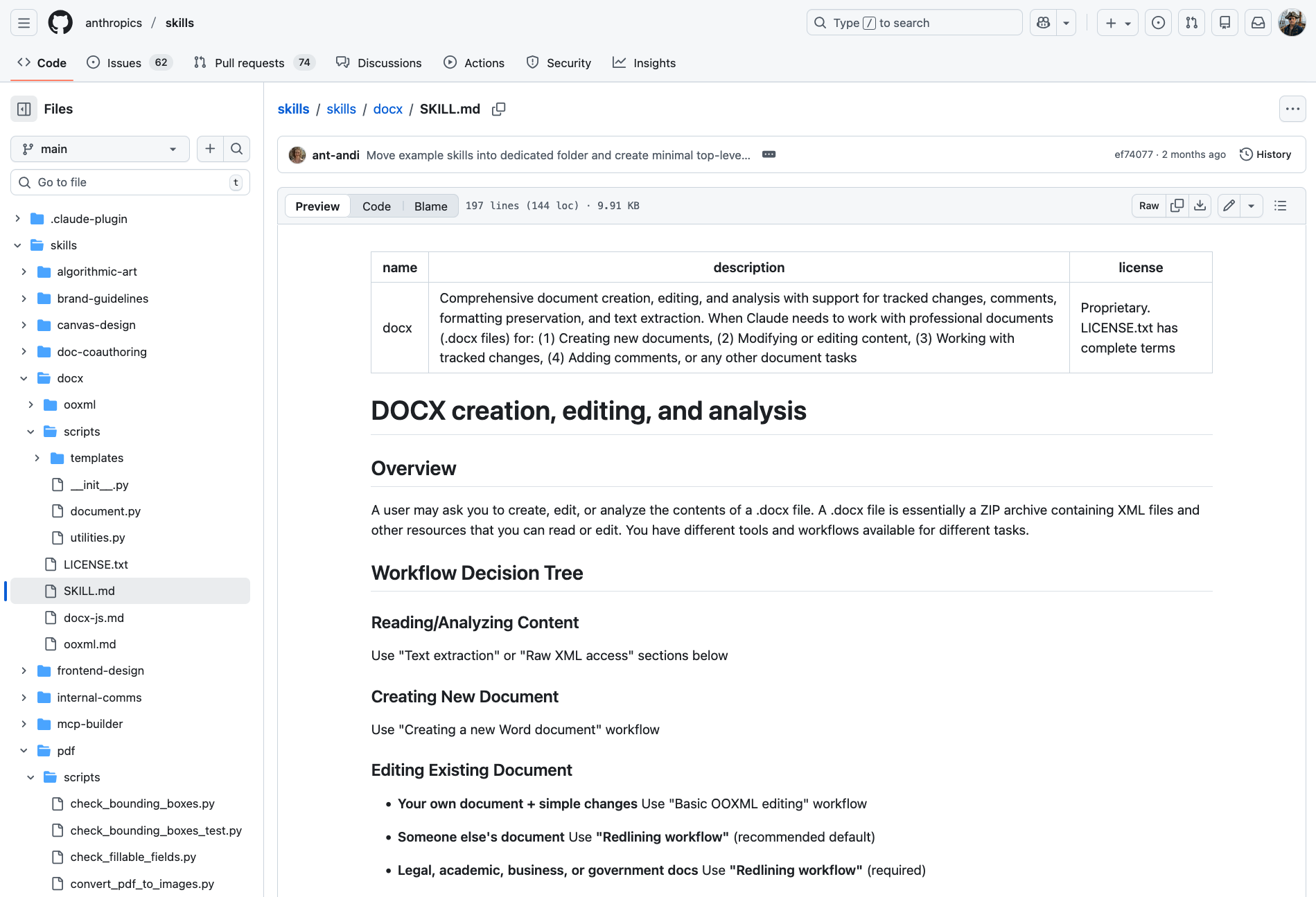
At this point, it became clear that we were moving beyond the age of “cobbling together” Claude-based workflow solutions. Now we had an elegant abstraction for capturing the domain knowledge behind any business workflow. And Skills worked across all Claude surfaces: Claude.ai on the web, Claude Desktop on Mac and Windows, and Claude Code.
Sharing Skills: Claude Code’s Plugin Marketplaces
On November 3rd, Anthropic announced Plugin Marketplaces for Claude Code. Plugins are Anthropic’s name for a category of artifacts that Claude Code users might want to create, reuse, and share, including slash commands, hooks, agents, and—you guessed it—Skills. Plugin Marketplaces are public git repositories hosted on GitHub, Gitlab, etc. that contain these artifacts, and that any Claude Code user can attach to and download from. Installing a Skill or other artifact takes just a command or two in Claude Code. The Plugin Marketplace repo design is another elegant piece of work by Anthropic and, among other things, supports Skill versioning.
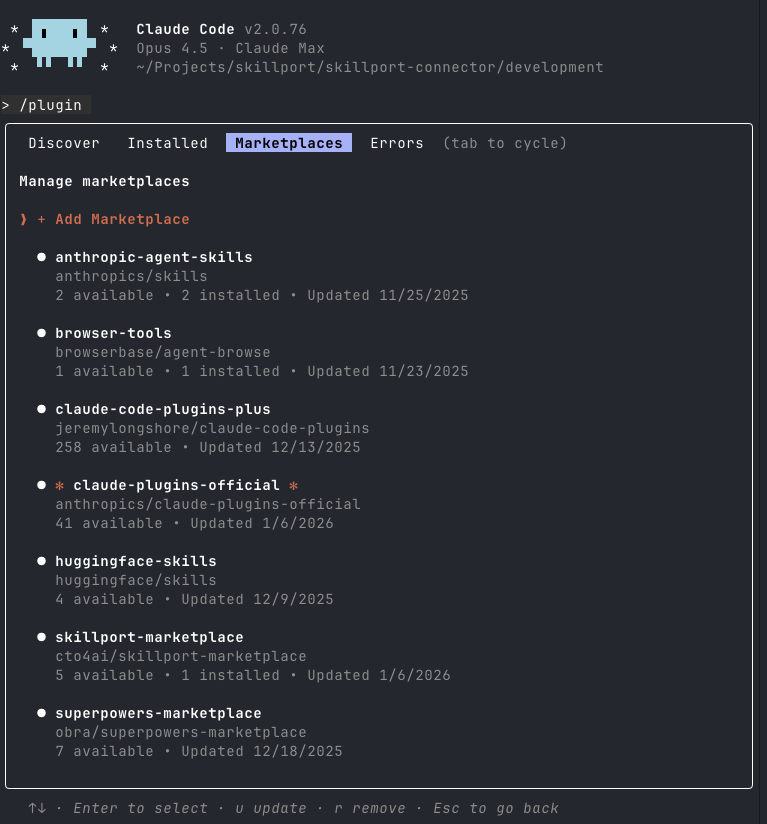
Plugin Marketplaces were very exciting, but also a groaner, because they target only Claude Code CLI (read: developers running Claude Code in a terminal interface), and only work with public repositories, a non-starter for proprietary business workflows.
Packaged, Context-friendly, Performant MCPs
Anthropic’s Model Context Protocol has seen tremendous uptake and support, but it has faced significant challenges to adoption as well. In Claude.ai and Claude Desktop, MCPs have been difficult to install at best, and not available at all in some cases (local MCPs with Claude.ai). Every installed MCP, even if it’s not being used, eats up precious model context tokens—the more tools the MCP exposes, the higher the context overhead. Finally, the standard model-to-MCP-tool back-and-forth tends to result in laggy performance.
Anthropic has been steadily chipping away at these MCP downsides.
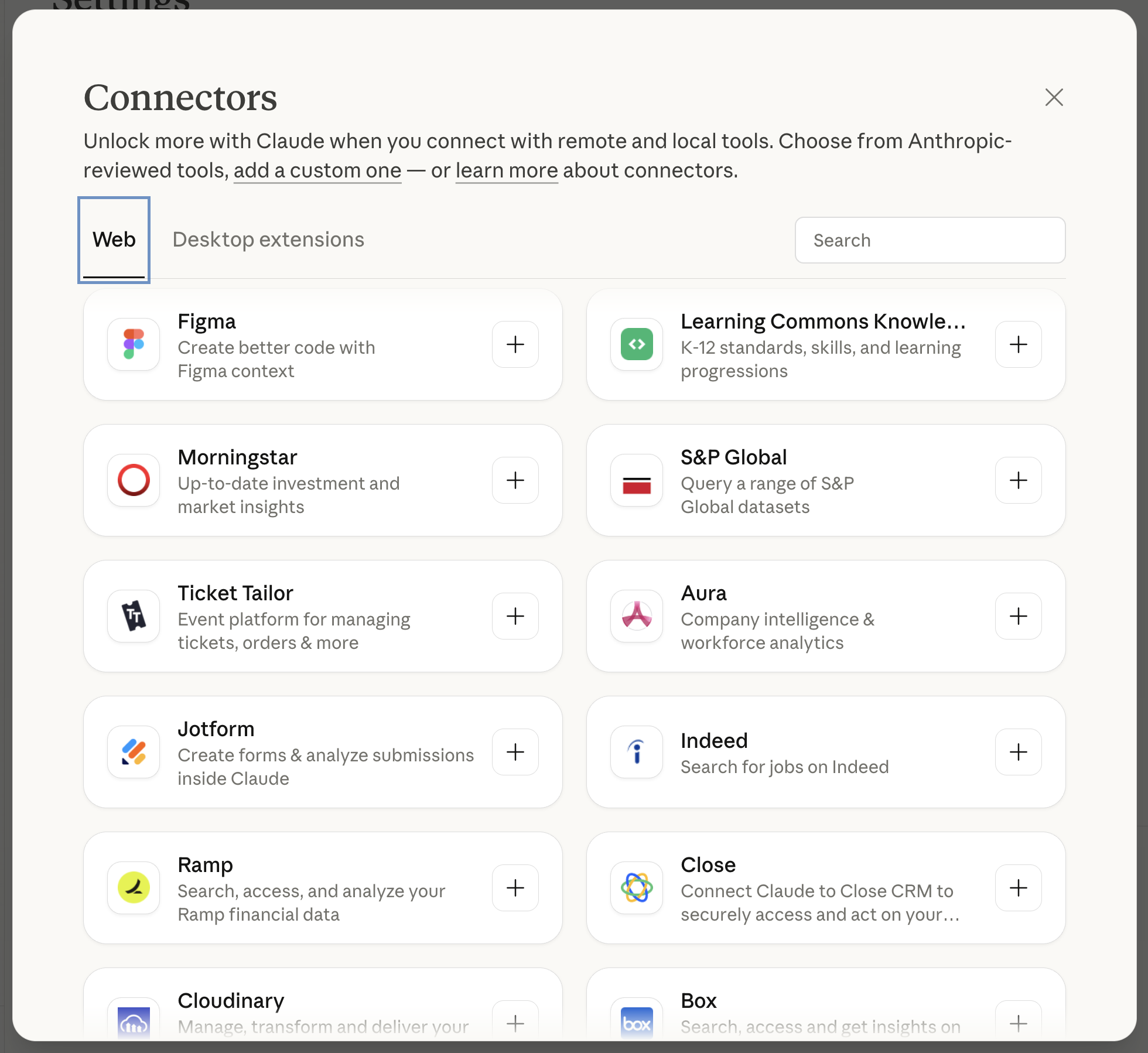
On the MCP distribution front, Anthropic announced a standard for one-click-installable Desktop Extensions (local MCPs) in June; followed on with Connectors directory, supporting one-click installs of cross-platform Remote MCPs, in July; and in November launched MCP Bundles (MCPB), the successor to Desktop Extensions. By end of year, the official Connectors directory was solidly populated with MCPs for many major platforms:
On the context efficiency and performance fronts, November was a big month: possibly spurred by Cloudflare’s “Code Mode” research, Anthropic began recommending and supporting a radically context-efficient and performant mode of model-to-MCP interaction, Programmatic Tool Calling. In a nutshell, instead of the model directly interacting with MCP tools, sifting and sorting their outputs, gobbling up huge chunks of context, the model instead writes code that does all that. As a result, the model no longer bears the context weight of all the intermediate tool call results, and no longer incurs the performance penalties of long, chatty conversations with tools. Anything that improves MCPs and tool calling is a big win for Skills++.
Ubiquitous, Sandboxed Code Execution in the Cloud
If you’re going to have powerful skills like “create and edit files” that use scripts, or get the benefit of Programmatic Tool Calling, you need a place to run code—one that works on all Claude surfaces, including Claude.ai on the web. Anthropic anticipated this need and began delivering on it in May, with Code Execution (of Python scripts) arriving as part of the Claude 4 platform. In August, Claude added the ability to run Bash scripts and perform file system operations. All of the above were prerequisites for Skills generally and the “create and edit files” Skills specifically, which launched just a few weeks later. October brought us Claude Code on the Web, a long-running-agent-loop mode for Claude Code that was completely reliant on sandboxed code execution in the cloud, as well as sandbox networking with egress controls.
Finally, in December, Anthropic acquired Bun, known for its blazingly fast JavaScript/TypeScript runtime that dramatically outperforms Node.js on startup time and execution speed. The acquisition signaled Anthropic’s commitment to owning the code execution layer that Skills++ depends on. Fast, lightweight runtimes are essential when you’re spinning up thousands of ephemeral sandboxes for Programmatic Tool Calling and Skill execution across all Claude surfaces.
The Christmas Itch That Needed Scratching
All of these great announcements and releases, so much promise … but heading into the end of year lull, I still didn’t quite have what I needed to really do business workflow automations right and to help clients deploy Skills at scale.
The main gap, to me, was Skill distribution and sharing. I wanted the elegance of Plugin Marketplaces, e.g. git repo based with Skill versioning, but without the public repo constraint and supporting all Claude surfaces. Would it be feasible to create a project that extends the Plugin Marketplace concept to support private repos, authentication, and get it working across all Claude surfaces?
For me, there’s always another question as well: would I learn something in the process?
I decided to go for it: start date Dec. 17th, initial release Jan 4th. So far, the answer to both questions seems like YES. Here’s what I built.
Skillport: Claude Skill Sharing at Scale
Skillport helps organizations deploy, share, and manage Skills at scale and without limits:
- Works across all Claude surfaces:
- Supports “normal Skill user” operations: find, install, update Skills.
- Supports “Skill creator / editor” operations: create, edit, version-bump, and delete Skills.
- Skill repositories use Anthropic’s Plugin Marketplace format, ensuring compatibility
- Private repositories are supported, enabling secure sharing within an organization (including Claude Code)
- Skillport’s Claude-compatible Connector carries the lowest possible Claude context overhead: one tool only
- Claude’s user interactions with Skillport are guided by Skillport’s own skill
- Skills are versioned and users can check to see if upgrades are available to any installed Skill
Open Source, MIT License
Skillport was released publicly on GitHub on January 4th 2025 under the MIT license, and consists of two repos:
skillport-connector, which enables an organization using Skillport to create their own Claude Connector (remote MCP) that authenticates over OAuth and provides access to a complete API for installing and managing Skills. The initial version supports Google OAuth and deploys to Cloudflare workers, but fork the repo and have at it, extending to other OAuth IdPs and deployment targets should be low-effortskillport-marketplace, a GitHub template that creates an Anthropic Plugin Marketplace compliant repository where organizations can (privately!) manage their library of Skills
The Skillport Skill
Skillport uses Skills itself, and in a rather novel way. The skillport-connector exposes just a single tool to Claude – authentication – and guides Claude to download and install the skillport Skill. With that Skill installed, Claude has full knowledge of how to interact with Skillport and use the full suite of Skill management tools. Claude-to-Skillport interactions take place via Programmatic Tool Calling rather than high-context-overhead MCP tools.
I learned a lot, I suspect Skillport will be useful for my fractional CTO clients, and I hope others find it helpful too.